BookBit by Jenn David Lang

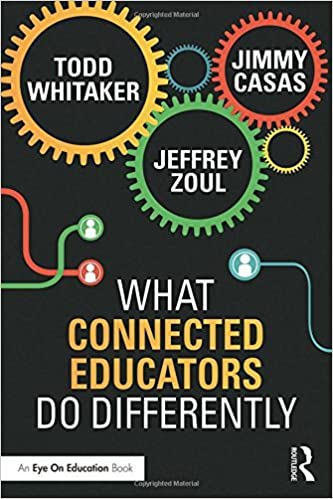
What Connected Educators Do Differently
By Jimmy Casas, Todd Whitaker, and Jeffrey Zoul (Routledge, 2015)
What are the main ideas?
- When educators connect with other professionals through social media to seek answers, share insights, and spark innovations, it improves teaching and learning locally — and across the globe.
- Connected educators take specific actions that make them more effective, knowledgeable, and inspired, than those who remain less connected.
Why would a school leader want to read this?
Here’s one of my favorite lines from the book: “Today, the smartest person in the room is the room.” In a digital world, it is our collective energy and passion that holds the key to our success. This is especially true as we face the current COVID-19 pandemic and nation-wide school closures. No teacher, administrator, or expert has ever navigated these waters, and no single person has all the answers — we are better, smarter, and stronger together. As individuals, we will learn more and grow more when we are part of a larger, connected network.
This book is for any educator who is ready to tap into the online global collective — a collective that is already thriving in places like Twitter — in order to seek solutions to current challenges as well as to improve their personal and professional lives. If you are looking for deeper conversations, stronger supports, and innovative answers, the authors insist now is the time to get connected and start building an online personal learning network. (Well, the authors say the best time was probably 20 years ago, sort of like the best time to plant a tree, but the second-best time is now!)
Particularly now, when educators are searching for and sharing strategies to handle the current COVID-19 crisis, the place to look is online. There are vibrant conversations about what COVID-19 means for schools today and in the future everyday — you only need to join in.
So, what does it mean to be a “connected” educator? It means we engage as participants in online communities in order to open ourselves up to “voices other than the ones inside our heads.” We develop relationships with educators and experts in education-related fields across the country and around the globe as we seek answers, share ideas, and challenge each other’s thinking.
We invest wholeheartedly in these communities but make no mistake, our online networks ultimately serve the work we do in our schools and in our classrooms. Connectivity is not a replacement for face-to-face relationships. The ultimate “pay-off” is our ability to bring new energy, inspiration, and innovations home to students.
What do connected educators do?
Being a connected educator starts with the mindset: I am worth it, and I deserve great things. It can be easy to get stuck in a rut or accept the status quo, especially if we feel things are “good enough.” But we must not settle for good enough — we have to strive for greater connections and growth. Even the authors admit they were initially reluctant to reach beyond their comfort zones to make new connections because they felt relatively successful with their routines. But then they saw how much richer their professional lives became once they were engaged in an online network, and they set out to share their experiences.
The authors’ advice is clear. Once educators are ready to connect, i.e. they decide their success is worth their personal investment, they can take intentional actions that highly connected educators take in order to grow and learn professionally so that they can best serve schools and students. These intentional actions are highlighted below. If you pick up the book, each chapter provides even more concrete steps you can take with suggestions for Follow 5 (5 educators they suggest you follow online), Find 5 (5 online resources), and Take 5 (5 next steps you can take to become a connected educator).
What connected educators do:
Build a Personal and Professional Learning Network (aka PLN)
The first vital step in becoming a connected educator is to build our PLN (note this can stand for personal or professional learning network but the authors say we’re really building both. They call it a P²LN but I will use the more common term, PLN). One of the ironies of teaching is that we spend most of our time in “professional isolation” (a fact that is even more pronounced with school closures). While on a typical day we might spend several hours surrounded by kids, most of us can count on one hand the number of daily, meaningful interactions we have with other professionals in our field.
The first step in becoming a connected educator is finding our people. In order to do this, we must think beyond traditional connections: phone calls, emails, and conferences. If we are really honest, we need to move beyond our school walls and the same 10 or 20 people we see each day (not that we do not love them or learn from them, but we need more).
The authors don’t beat around the bush here: If we want to get connected, it’s best to jump into the largest learning network on the planet — Twitter. Why Twitter? If we want to experience the greatest professional and personal growth and make the greatest impact (in our school — or beyond), we want the largest audience with whom to connect. Right now, Twitter gives us this. Right from the start, the authors prepare us with practical steps to join Twitter and other online communities. Check out the book.
Focus on The Three R’s: Relationships, Relationships, Relationships!
I know what you might be thinking (because I used to think it, too), “I don’t get Twitter. I don’t care what Justin Bieber has to say!” Don’t be fooled by misconceptions: Connected educators can and do utilize social media to establish vibrant, relevant PLNs.
Twitter can be used to cultivate professional ideas, spur growth, and build genuine friendships. These things occur when members trust one another to support their ideas and challenge their thinking in productive ways.
One real advantage of building a PLN through Twitter (or similar social media platforms) is that we can expand our circles to include more educators who do not think and act like we do. You see, true connected educators value diversity and dissent. They know intellectual “skirmishes” from within their trusted network help them to expand their thinking and ultimately to become better teachers and leaders.
If you are still skeptical about the power of Twitter to provide these rich experiences, relax: The authors provide solid tips to ensure your first steps in the “Twittersphere” — from profile building to hashtag use — lead to meaningful learning and connections from the start.
Learn and Share How They Want, When They Want, and What They Want
Sure, PLNs can expand our networks and help us connect with others, but if we are already overwhelmed with work, why would we add more to the plate? The fact is that connected educators are empowered educators. They willingly invest time in their PLNs because these networks give them full control over their professional growth and learning. No longer limited to (or trapped by) traditional professional development, motivated educators can use PLNs to seek, explore, or discuss topics that inspire them whenever they want. Think of it as “extreme personalized learning” for grown-ups.
Connected educators also use social media to take control of the messaging regarding their school or topics that impact them. Consider it this way: for far too long, people outside of education have controlled how schools are viewed or how education policy is formed. But tech-savvy educators can use social media to promote their school communities and a pro-education message of their own. With schools closed, there is no better time to remind your community about the positive impact your school continues to make in families’ lives. Raise up your teachers as the “superheroes” they are, and honor your students as the resilient young men and women they are learning to be in these challenging times. There is definitely more to Twitter than celebrity news!
Give, Take, and Steal the Good Stuff
Someone once said, takers eat well, givers sleep well. Great news! Connected educators do both: They are givers and takers. As givers, they respond consistently to others in their PLN: they offer advice and share ideas, they promote others by sharing what they learn from them with their own networks, and they connect people to their peers. Although self-improvement is every educator’s goal, givers understand that they learn more when they engage in supportive relationships and help others become better at the same time. As “takers,” successful educators are always on the prowl for new and better ways of doing things. In order to reach their goals faster, they go beyond their school’s walls to learn what is working across the country or the globe. They take the best of what others have done (with their blessing, of course) and make it their own by applying it to their own students, classroom, or school.
There is no better time than during this crisis to share what’s working at your school and learn what’s working in other schools.
Strive for Greatness
Are you cut out to be a connected educator? It might not be for everyone: Connected educators are determined to create change, regardless of the obstacles they face, and are always striving to be better. These changemakers are not afraid to take risks or embrace vulnerability to reach their goals. This means they are willing to use their voice in the public domain to find better solutions or share their vision with others. Let’s face it: being a connected educator requires commitment and boldness, but the stronger your PLN is, the easier it is to make these bold moves. How can this be? Surround yourself with inspired people and ideas, and suddenly you become more inspired and passionate — and you pass those virtues on to others. It’s like a self-fulfilling prophecy or the circle of life — you get the picture.
Know When to Unplug
There’s one caveat in this push for “connectedness” — being plugged in too much can be counterproductive to growth and learning. Too much time online may mean less time with students or engaged in real-world planning. So, what does a connected educator do to maintain that elusive balance? She sets aside time to de-stress away from work and her PLN. She intentionally schedules time to unplug or she might not do it. She creates space in her week for physical activity, quiet reflection free from distractions, and pleasure reading (preferably with a cup of tea). She also models these actions to encourage colleagues to maintain balance, too.
Lead the Way for Others
Connected educators aren’t just engaged members of their online networks — they are inspired leaders in their own schools, too. They strive to make a greater impact by taking what they receive from their learning network and translating it into actionable steps in their own schools or districts. This is where the power of PLNs truly lies — when connected educators share their learning in ways that impact the leaders, teachers, and students they serve every day. They wake up each morning looking forward to going to work and ready to make a difference.
Suggestions from the book and The Main Idea to bring learning and connection to your school community:
- Join the Conversation about COVID-19: Use this time when we’re all searching for ideas as an opportunity to get your feet wet with Twitter. Start by researching what schools are doing in response to COVID-19. Since all schools are responding and no one has done this before, there is a lot of information circulating on social media. Choose a few topics you are interested in and search. Interested in what schools are doing about grading? Search #grading. Interested in how schools are serving Special Education students during this crisis? Search #SpEd. Want to see how educators are handling the crisis in general? Search #remotelearning.
- Share with and Grow Your Network: Start a “This Week on Twitter” e-newsletter with staff or colleagues to share your learning. Include thought-provoking tweets, blog posts, videos, graphics, or other resources. Ask others to send you their favorites, too, so you can highlight them at a future date.
- Elevate Your Students’ Voices: Create a student leadership team and host a monthly meeting on Zoom (or Google Meets, etc.) with them to discuss what you can do together to maintain school community and continue to create a culture of excellence during your school’s shutdown. Students are also powerful messengers. Ask them how you can work together to share the good news about your school on social media platforms that will appeal to young people and parents in the community.
- Host Connection Workshops: Once you understand the basics of Twitter, it only takes a few minutes to train someone else. Offer to host online onboarding sessions to help your staff get connected. Give some basics for getting started: profile tips, how to conduct searches, and “top 10 do’s and don’ts.” At the end, provide a way for participants to share their handles so they can connect with each other right away (build those networks now)! Add later sessions for other platforms such as LinkedIn, Voxer, Instagram, etc. I’m sure your teachers will return from distance learning with new digital connection skills of their own to share, too!
- Build(ing) Connections: In the future, when you host a traditional meeting or conference, provide an opportunity for participants to connect easily online after the event. One suggestion: Leave a Twitter handle (or LinkedIn profile name, etc.) signup sheet at the entrance. Anyone open to connecting with others in attendance can leave their information on the sheet and you can post it at the end. Also, check out the authors’ lists of suggested Twitter accounts to follow and more at: www.routledge.com/books/details/9781138832008 (click on eResources).
© The Main Idea