The Instructional Leader’s Guide to Closing Achievement Gaps:

Five Keys for Improving Student Outcomes

By Teresa D. Hill (ASCD, 2024)

S.O.S. (A Summary of the Summary)

The main ideas of the book:

~  Every educator knows about the achievement gap, but many do not know what they can do to close the achievement gaps in their own schools.

~  While some gap-causing factors are outside of schools’ control, there are five key factors schools can leverage for major impact. To get schoolwide, gap-closing power from these levers, school leaders must show the way.

Why I chose this book:


As leaders it can feel overwhelming to decide where to start to address achievement gaps. I appreciate the expertise of veteran educational leader, Teresa D. Hill, who has spent her career combatting achievement gaps. From her research and experience, she helps us focus on five high-leverage areas in her latest book.

If you’ve ever felt powerless in the face of the problems impacting your students’ academic achievement, this book is for you. The Instructional Leader’s Guide to Closing Achievement Gaps explains exactly how you can use five key levers that are within your control to close those gaps.

The Scoop (In this summary you will learn…)

***Click here for my 1-pager and here to listen or watch my interview with the author on YouTube.

Introduction: Understanding Your School’s Achievement Gaps

For decades we’ve been hearing about “the achievement gap.” It’s in the news, and it’s the subject of academic studies. But researchers and journalists mainly focus on describing the “gap” and its possible origins. There is very little practical guidance for teachers or leaders on the front lines when it comes to what to DO about the gap. The aim of this book is to provide support to frontline educators seeking to improve student outcomes.

Educators need to work in their own “zone of power.”

Some factors, like poverty, certainly impact student achievement, but they lie mostly outside the school’s sphere of influence. But educators need to focus on what is within their control and do the absolute best they can in those areas. Hill identifies Five Keys for improving student outcomes that fall within educators’ “zone of power.”

Five Keys for Improving Student Outcomes

1
Meaningful
Assessment
2
Language
& Literacy
3
Experience
& Exposure
4
Consolidation
of Knowledge
5
Perfect
Practice
The upcoming sections of this summary describe each of the Five Keys in more detail.

The nationwide achievement gap is outside your zone of power. The achievement gaps (plural)
at your school, however, are not. You can directly impact the gaps at your school with your actions and decisions. Individual teachers can (and must) do this work in their classrooms, too, but closing schoolwide gaps requires systematic schoolwide efforts led by leaders, not just strong teachers.

Work to bridge your school’s achievement gaps.

Work on your school’s gaps with a carefully chosen team. Build a team made up of educators who bring a range of perspectives and experiences, and who share a desire to improve student outcomes without seeking to assign blame. Work with this team to begin the impactful work of bridging your school’s gaps by discovering exactly what they are.


Understand the gaps at your school by asking 4 questions…

1. What meaningful disparities in learning or performance exist among identifiable groups of students at your school?
Consider demographic groups like race, gender, socioeconomic status, and so on. Look at the intersection of groups, too. For example, are there disparities evident with Black, male students that you don’t see when looking at all Black students or all male students? Look for potential disparities in practical groupings, too, like students with first period math or novice teachers.

2. How wide is each gap and how big is the group it’s impacting?
One group might represent a small percentage of the student body, while another group represents half or more. One group might lag far behind in reading scores while another group lags only a little. Describe each of your school’s achievement gaps in detail. Don’t forget, sample size matters. If you look at just 20 kids, for example, one or two individual differences could skew the data.

3. When and where do disparities appear and how do they progress?
Is a gap more evident on one assessment than another? In one subject area but not another? Are there events that appear to have triggered certain gaps? Do any gaps change or appear over time? For example, a large disparity in 4th grade might be traced back to a small disparity in 1st grade.

4. What are the sources and perpetuators of each disparity?
Remember, some of the sources may be outside your control, but understanding them will help you determine your approach. And don’t forget there may be sources within your control, too. Perpetuators didn’t cause the gap, but they make it worse. For example, if kids who read below grade level are pulled out for intervention, missing core instruction could perpetuate an existing gap. Of course, you won’t have perfect information about the sources and perpetuators of every gap, and reasonable people may even disagree. That’s okay. Having a thoughtful discussion about sources and perpetuators is a good starting point.

Next, consider the Five Keys available to you that fall within your zone of power. Your aim should be to develop the capacity of the staff at your school to use these keys to help narrow and close your school’s achievement gaps. Read on to learn about each key.

Key 1: Meaningful Assessment

1
Meaningful
Assessment
2
Language
& Literacy
3
Experience
& Exposure
4
Consolidation
of Knowledge
5
Perfect
Practice

Unfortunately, the assessments that are used to identify and measure achievement gaps won’t help you close those gaps. They aren’t designed to promote learning. Meaningful assessments, designed with learning in mind and given to a select group of students, however, are one of the Five Keys educators can use to address gaps.

Meaningful Assessments Are… 

  • Timely — They should be administered and analyzed within two weeks. By the third week, teachers are able to tailor instruction to respond to the results to the assessment.
  • Focused & Sensitive — They assess a discrete set of skills and measure a student’s ability to use them to complete academic tasks. Avoid assessments that cover too many topics with too few questions. Better to have several questions looking at a single learning standard. They’re sensitive enough to show evidence of small improvements in performance.
  • Diagnostic — They provide a lens for examining student thinking. If the assessment doesn’t require a student to think much or is too difficult for the student to even attempt, it won’t give a teacher anything to work with. The assessment should reveal a floor (related low-level skills), table (grade-level skills), and ceiling (challenge for students who have mastered the standard). 
  • Authentic & Curriculum-Based — They should NOT be something that requires preparation specific to the test in order to do well (think SAT prep course, for example). They should be measuring an academic skill as directly as possible, not a test-taking skill. They are closely aligned with what the teacher is teaching in the classroom. 
  • Formative — They are designed for learning, not for producing grades. Meaningful assessments can be given repeatedly. Each time they are administered, the score reveals how learning is going and serves to inform upcoming instruction.

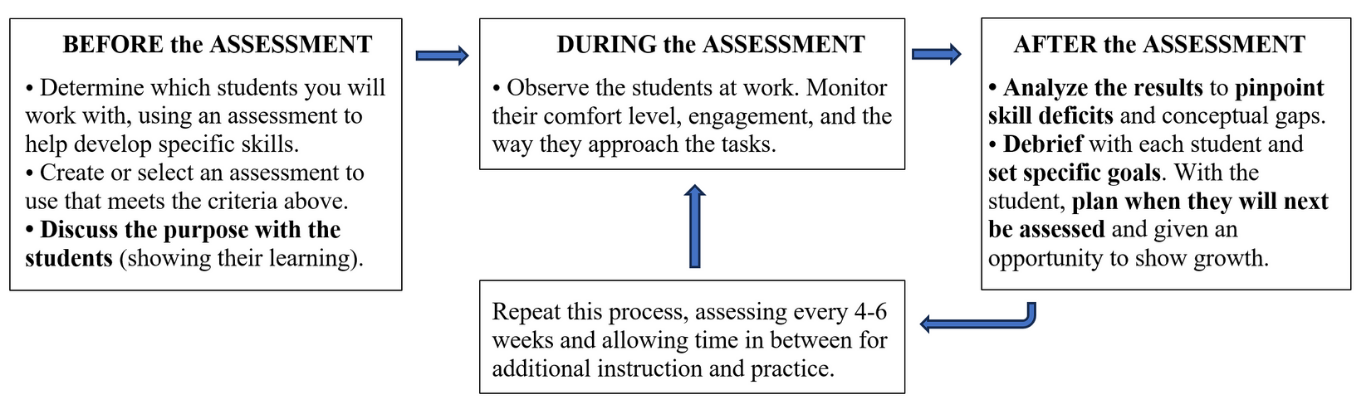
Use meaningful assessments to impact student achievement like this:

Finally, avoid these common assessment pitfalls. Don’t over-assess. Give only assessments with a clear and unique purpose. Don’t over-generalize results. Just because a student struggles in one area does not mean they struggle in all areas. Don’t rely too heavily on outside entities. Computer-based assessments leave teachers out of the loop and don’t factor in more human observations.

However, the biggest mistake is to assume that the assessments you use for all students will meet the needs of those who struggle. They will not. Instead, Hill provides a snapshot of how teachers might effectively use meaningful assessments specifically targeted for struggling students. After identifying a group of students with specific, defined needs, and selecting a meaningful assessment that looked directly at those needs, a team at one school did the following…

  1. A group of teachers and specialists divided up the list of students and administered the assessment over one week.
  2. As a team, they analyzed the results and created draft goals to discuss with individual students.
  3. They met with students individually, set goals, and planned a retest for six weeks after the initial assessment.

 As a leader, you need to honestly assess whether the assessment procedures you have in place are reaching this level of meaningful, personalized attention to students with performance gaps. It’s not enough to know they didn’t do as well as other students on the general assessments. They need a tailored approach with targeted assessments of their own to really benefit. If this doesn’t describe your current assessment methods, this is a key you will definitely want to leverage to address your school’s gaps.

Key 2: Language & Literacy

1
Meaningful
Assessment
2
Language
& Literacy
3
Experience
& Exposure
4
Consolidation
of Knowledge
5
Perfect
Practice

In addition to meaningful assessments that help educators monitor and understand gaps, language and literacy are essential to improving student outcomes. They function both as bridge-builders and gatekeepers in academics and in careers. While students may arrive at school with major differences in their language and literacy backgrounds (sometimes called the 30-million-word gap), the strategies recommended here are all within the school’s zone of power.

Expressive Language

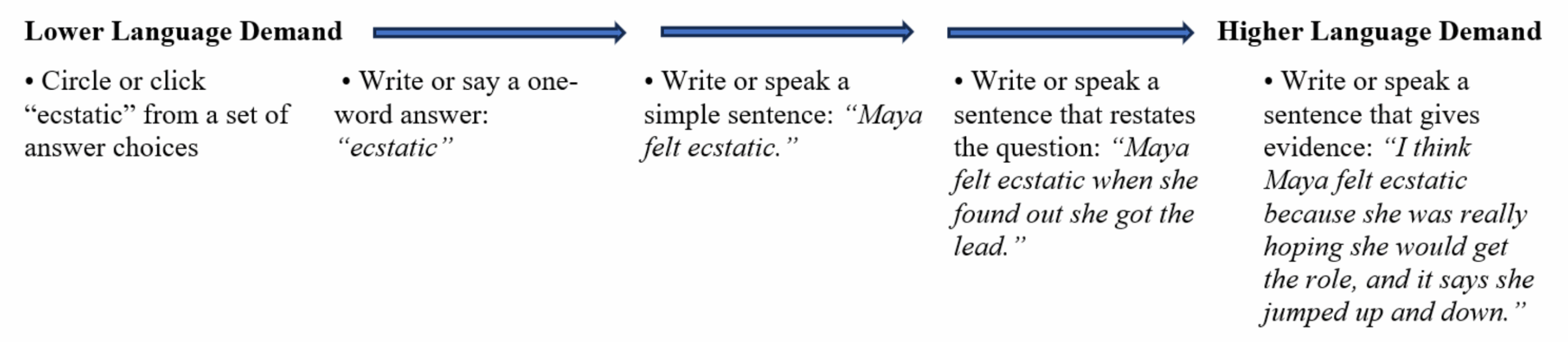
When it comes to expressive (spoken or written) language, expectations of students are much higher at some schools than at others. Take a look below at several ways to answer the same question on a scale of lower to higher language demand.

Use These 6 Language Expectations to Narrow Achievement Gaps

Expecting students to express themselves with more complex language is one lever a school can use to improve student achievement.

Staff will need to collaborate to effectively raise expressive language expectations across classrooms. Hill recommends the following 6 expectations for every student every day…

speak to respond to open-ended prompts from teacher

write multi-sentence responses

listen critically and respond to peers’ ideas

use evidence to make decisions or draw conclusions

• write to reflect and to develop thinking

ask questions to gather information or to clarify

Teachers should offer guidance (“Answer in a complete sentence”), instruction (“A complete sentence includes a subject and verb”), and modeling (“Water vapor condenses on the glass.”) as well as individual supports to students who need it (English language learners, for example). Give supports like sentence frames temporarily but gradually decrease support over time so students progress.

Literacy

In addition to expressive language, reading is a formidable gatekeeper in academics and careers. While all educators would say they value literacy, that doesn’t mean they’re already doing all they can for student literacy. Here are the top 5 literacy levers that schools must use if they are aiming to close their achievement gaps:

  1. Use the Science of Reading. Most educators are aware of the Science of Reading, but many were not trained on it in their teacher preparation programs. Make sure all teachers have the skills and resources they need to provide evidence-based literacy instruction.
  1. Provide concurrent skill instruction. Students who read below grade level still need to receive full instruction in all grade-level comprehension, critical thinking, writing, and other skills. They need to be taught these skills in addition to improving their decoding. 
  1. Ensure frequent and wide reading. Students need access to a wide range of books, both fiction and non-fiction, on a variety of interesting topics. They also need time and encouragement to read. Beyond just teaching kids to read, get them reading! 
  1. Emphasize the reading/writing connection. Students should be taught to see texts as a product of authors’ ideas and choices. They should also be writing regularly in response to what they read and answering text-dependent questions.
  1. Build a culture of reading. Weave reading into the everyday life of your school. Find times to joyfully sneak in reading. Celebrate reading with schoolwide events. Make sure staff members model what it looks like to be life-long readers.

Key 3: Experience & Exposure

1
Meaningful
Assessment
2
Language
& Literacy
3
Experience
& Exposure
4
Consolidation
of Knowledge
5
Perfect
Practice

The aquarium, the pumpkin patch, the science museum…for some students, places like these have been a part of their lives since they were toddlers. For others, they are places they’ll never go unless their school takes them.

Experiences like these are building blocks of essential background knowledge. In addition to meaningful assessment and language and literacy, experience and exposure are key to closing your school’s achievement gaps.

Without background knowledge, gaps will persist. Reading comprehension suffers and so do critical thinking skills like comparing and contrasting. Experience gaps perpetuate achievement gaps, because the more background knowledge a student has, the easier it is for them to acquire even more, widening existing divides. Schools must step in to provide experiences for all to help close the gaps.

Plan and Deliver a Curriculum of Experiences

Unless you intentionally map out and plan for “experiences,” it’s easy for these to fall through the gaps. Begin by listing any field trips or other hands-on, context-building experiences you already provide for students. Organize them by grade level and note their connections to the curriculum (see the chart below).

Assess your list, then add on with an eye to ensuring students get a wide range of experiences that connect to the curriculum (science, social studies, the arts, etc.). Some experiences also provide learning beyond the curriculum, such as how to behave in a theater.

Think broadly about what experiences are available in your community. Businesses and public institutions (bakery, bank, city hall, etc.) might be willing to give students an educational look behind the scenes. Non-profits or universities might have experts who could provide students with hands-on education (like teaching them how environmental scientists monitor the health of a stream).

Once you’ve built a matrix of experiences across grades and subjects, commit to providing them to all students as core part of your school’s curriculum. Ensure that all students have access. Field trips are not unimportant extras. They engage learners physically and emotionally as well as cognitively, which helps to embed learning in long-term memory.

Make Sure Students Learn from Experiences

 What you are NOT aiming for is an activity that is “so fun the kids don’t even know they are learning!” Fun is great, but students need to know what they are supposed to be learning. For students to benefit academically from experiences, teachers must purposefully incorporate critical thinking, vocabulary development, and reflection both before, during, and after an experience.

BEFORE: Preview expectations (both what it will be like and how students should behave), clarify what the students should be learning about, provide “look-fors” and “listen-fors,” and explain expected methods for recording their observations.

DURING: Remind students of expectations and learning objectives. Make sure students have materials (e.g. graphic organizer, pencil, clipboard) for taking notes if they are expected to. Open-ended prompts help students take in the whole experience rather than just seeking out fill-in-the-blank answers. Draw students’ attention to the essential “look-fors” and “listen-fors.”

AFTER: Have students reflect on the experience through writing, discussion, or both. Use consolidation of knowledge activities (in the next section) to help students clarify and remember what they learned.

What about virtual experiences?

 Can schools use videos or other virtual methods for filling gaps in experience? Yes, and no. Students can learn from virtual experiences (the same purposeful approach should be used before, during, and after). But videos and even interactive online experiences are NOT interchangeable with real life. In-person, hands-on learning experiences are concrete, while videos are abstract.

 Kids spend a lot of time in school learning in abstract ways (reading, writing, watching videos, etc.). But they will get more out of abstract learning when they have concrete experiences to complement the abstract learning. It’s vital that students learn in both abstract and concrete ways whenever possible.

Key 4: Consolidation of Knowledge

1
Meaningful
Assessment
2
Language
& Literacy
3
Experience
& Exposure
4
Consolidation
of Knowledge
5
Perfect
Practice

Whether they learn on a field trip or inside a classroom, students need to connect their new knowledge to something they already know in order to hang onto it. Consolidating knowledge is the process of forming these connections. Consolidation puts knowledge in long-term (instead of short-term) memory and enables them to more readily apply it in novel situations (transfer learning!) Knowledge consolidation is the 4th essential key to closing achievement gaps.

4 Main Consolidation Methods

  • Connection – Connect new knowledge to the learner’s experience or existing knowledge. Level up by moving from “Have you ever ____?” to “How does that connection affect your understanding of this?” or “Why does that connection matter?”
  • Reflection – The learner thinks about their own thinking and experiences and how they are impacted by new knowledge. For example, ask students, “What strategies did you try when you played the math game? Were they effective or not? Why?”
  • Interaction – The learner uses new knowledge to communicate, cooperate, or compete with others. For example, working with a partner and using new knowledge about friction to increase the speed of a toy car. Note: Educational websites that call themselves “interactive” frequently do not provide the degree of interaction needed to consolidate knowledge.
  • Integration – The learner combines old and new knowledge and skills to achieve a new level of understanding. For example, students combine learning from math and science to build a model bridge. Or students combine learning from language arts and social studies to write an opinion essay about an historical event.

Students can engage in these methods by writing, speaking, discussing, debating, creating a representation of some kind, performing, or executing a task. Different methods lend themselves well to specific subject areas (for example, making connections works well in reading and interaction works well in math), but they don’t need to be limited to their most obvious subjects. If you want to close achievement gaps, educators must plan intentionally for students to engage in consolidation of all new knowledge.

Sit down with grade level or subject-area teams to go over the existing curriculum. Map out the consolidation methods the teachers are already using in each unit. Determine where more consolidation is needed. Or perhaps you need to vary the methods more to make sure all students are engaging. Ask teachers to consider whether they need to teach students new routines for consolidation, and work with them to determine when that will happen.

Common Consolidation Pitfalls to Avoid

X DON’T assume that just because students were presented with some new information, they have automatically integrated it into their thinking and committed it to memory. Provide specific strategies, activities, and assignments for the purpose of consolidation.

X DON’T reserve all consolidation for the end of a unit. It’s too easy to run short on time and skip it or rush it.

X DON’T offer consolidation assignments and activities only to advanced students or those who finish their work early. All students, especially struggling students, need consolidation.

X DON’T provide excessive prompts to get students to make the “right” connections or draw the “right” conclusions. This trains students to expect that they won’t have to think but will have correct answers handed to them.

Key 5: Perfect Practice

1
Meaningful
Assessment
2
Language
& Literacy
3
Experience
& Exposure
4
Consolidation
of Knowledge
5
Perfect
Practice

Even with effective consolidation placing new knowledge and skills into long term memory, students need many opportunities to retrieve the new knowledge and practice their new skills. Students struggling with performance gaps will not benefit enough from traditional practice methods (like assigning some practice problems for homework). The practice that will effectively help close achievement gaps is the practice that happens when intervention is done well.

This is another chance for a school (teachers and leaders) to work within their zone of power. It is true that some students never do homework. It is true that some students’ lives outside of school lack quiet spaces or supportive adults that make homework more doable. But at school, teachers and leaders can use coaching and intervention, planned well and carried out with intention, to ensure perfect practice is happening regardless of homework habits.

Educators Must Coach

Imagine a tennis coach observing an athlete practice. The coach analyzes her serve, her stance, and so on. The coach notices what the athlete does well and where she needs to improve, then teaches, demonstrates, and assigns specific exercises aimed at improving the athlete’s game. Elite athletes often get coaching like this in tennis or other sports. But struggling students need coaching in the subjects that challenge them most in order to make their practice beneficial.

4 Steps for Coaching Perfect Practice 

  1. Closely monitor a student as they complete a task. Notice what they’re doing and how it compares with what should be done.
  1. Analyze their process and identify ways they can improve. Are they making mistakes or demonstrating misconceptions?
  1. Directly address the mistakes and misconceptions with the student. Show them correct procedures as needed.
  1. Observe as they complete additional tasks involving the same skill. Continue coaching until they consistently do the tasks correctly.

Additionally, schools need to make sure that the interventions they provide to struggling students are effective and aren’t just “going through the motions” of an intervention without really achieving the goals. Getting intervention right requires planning and intention on the part of the teachers providing it AND on the part of school leaders who must ensure the schedule is realistic, attendance issues are addressed, and more. But the good news is, everything on the checklist below is within the school’s zone of power.

Effective Intervention Checklist

__ It matches students’ identified needs and skill gaps.

Even when an intervention is “research based,” there must be evidence that it works for students who need what your students need. It happens too often that students get interventions that are not aligned with their needs! Skill gaps will have worsening impact over time as new concepts build linearly, so it’s essential that interventions address students’ actual gaps. 

__ The educator who implements the intervention understands the key elements that make it work.

Having a script to follow “with fidelity” is not enough on its own. The adult needs to understand why it works and how.

 __ Schedule (and protect) ample time for intervention in addition to (not instead of) core instruction.

This looks like 2-3 hours of supplemental instruction per week, in blocks of 20-60 minutes. Make sure to account for transition time. Do not allow intervention to replace core instruction. Struggling students need both. 

__ Interventions are instruction, not just activities.

Interventions include direct instruction plus modeling and guided practice of a specific, targeted skill. Students should practice a skill several times up front and then return to it after a break. Both repetition and reinforcement are necessary. 

__ Students are present and fully, actively engaged.

No student should be going through the motions of a task like it’s busy work or waiting around for others to finish. And, it should go without saying, but students need to be there to benefit. Get to the bottom of attendance issues or work around them if needed. A student who’s late frequently should not have intervention at 8:00 AM when they’ll seldom be present.

Conclusion

It’s easy for educators to get overwhelmed or even feel hopeless when staring down data on student achievement gaps. We got into education to lift students up, to hold the door open for the next generation, to help level the playing field. Seeing gaps in performance persist despite your hard work is tough. While you can’t single-handedly close the gap for all students everywhere, you can have a major impact on the performance gaps in your own school or district. Focus on effective action, using the 5 keys, within your own zone of power, and you will see change.

THE MAIN IDEA’s PD suggestions that go along with this book are not included in this html link. To see those ideas, go to www.TheMainIdea.net and download the full book summary.

THE MAIN IDEA is a subscription service for busy educational leaders.
Each month I send one education or leadership book summary along with PD ideas to use with staff. I also have other goodies – podcasts about the books, PPT workshops you can use, over 200 searchable book summaries in my archives, and more.